The Weekly Reset: A Practical Executive Function Strategy for Teens Who Struggle With Follow-Through
The Skill-Building Series

If your teen starts strong on Monday and shuts down by Thursday, you’ve seen this pattern before.
You watch them try.
You think they care, but you aren’t sure how they show it.
You’ve now watched their week completely unravel.
Last week, I wrote about why motivation fades and executive function fatigue setting in.
This week, I want to continually progress forward.
Understanding the brain is important, and that alone does not change outcomes.
Systems do.
If your teen is stuck in the cycle of start strong → stall out → feel behind, they don’t need more pressure.
They need structure.
Let’s talk about the kind of support that actually helps.
Why Teens Lose Motivation Midweek
Last week, I wrote about why kids start strong and then stall out.
Novelty creates dopamine. The brain’s “seeking system” lights up with new planners, fresh starts, and clean slates.
But that dopamine fades.
Once the novelty wears off, the prefrontal cortex, the part of the brain responsible for executive function skills, carries the load.
That means:
Planning
Working memory
Time awareness
Task initiation
Emotional regulation
If those skills are still developing, consistency and follow through becomes even harder.
Motivation gets teens started.
Executive function helps them finish.
When Overwhelm Turns Into Avoidance
Many teens do not just lose motivation.
They feel behind.
They feel unsure where to start.
They feel the weight of unfinished tasks.
Maslow’s hierarchy reminds us that higher-level thinking depends on emotional stability. When teens feel stressed or overwhelmed, the brain shifts into protection mode.
Avoidance becomes relief.
From the outside, it can look like procrastination.
From the inside, it often feels like freezing.
This is where routine and structure matters.
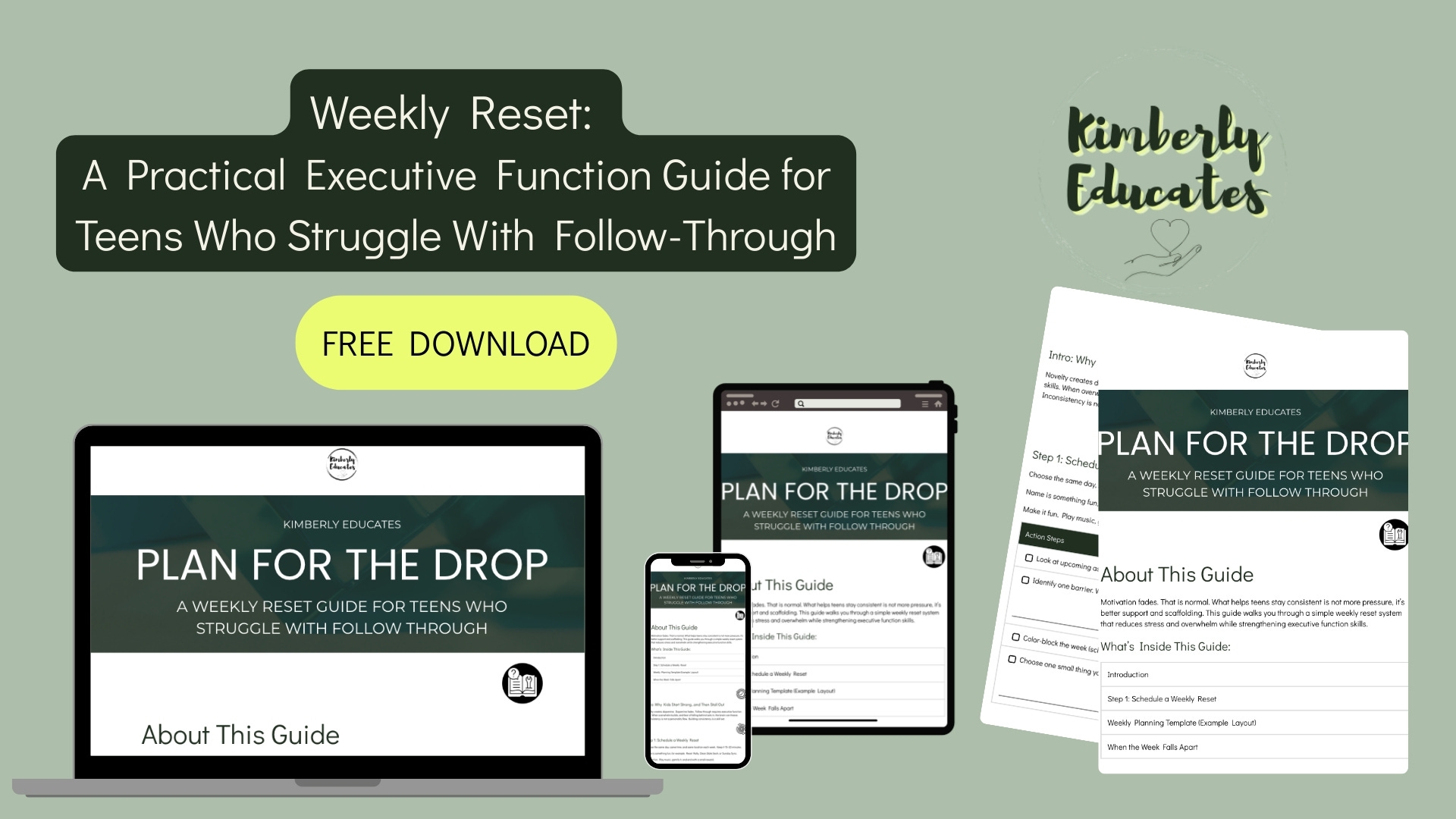
The Weekly Reset: An Executive Function Routine
The Weekly Reset is a predictable, weekly 15–20 minute check-in designed to strengthen executive function skills and reduce teen procrastination.
It gives teens:
A structured planning habit
A safe place to notice barriers
Practice restarting after setbacks
Visible next steps
It replaces “try harder” with “let’s make a plan.”
How to Set Up a Weekly Reset Routine
Choose:
The same day
The same time
The same location
Keep it short. Keep it predictable.
Give it a name:
Reset Rally
Sunday Sync
Clean Slate Session
Consistency builds trust and safety.
What to Do During the Reset
Review upcoming assignments.
Identify the most important task.
Name one barrier.
Color-block the week (school, movement, downtime).
Choose one small next step.
Examples
Barrier: “I don’t understand the math.”
Small next step:
Email the teacher to ask for help.
Text a classmate to ask for help.
Complete one problem that you do understand.
Barrier: “This all feels overwhelming.”
Small next step:
Open the document.
Write one sentence.
Executive function skills grow through small, repeatable actions.
When the Week Falls Apart
It inevitably will.
Recovery and resilience are part of building executive function skills.
Try scripts like:
“It didn’t go how we planned. Let’s pick one small next step.”
“You’re not behind. We’re adjusting.”
“What feels most important to start now?”
Perfection creates pressure.
Recovery builds independence.
I’ve attached the printable Weekly Reset Guide below so you can start using it now.
Start small.
Keep routines and structures predictable.
Let systems continue the momentum when motivation fades.